Cosmik January Updates



One of our New Year’s resolutions was to start sharing monthly updates, so here’s one for January!
Cosmik
- We have been busy co-organizing ATScience 2026, a full-day exploration of ATProtocol for science, education, and open knowledge happening as a side event to AtmosphereConf 2026 in Vancouver on March 27, 2026. We were excited to see many great proposals (more than 20 total!) and are working on finalizing the agenda in the next week or two. We’d love to see you there if you can make it!
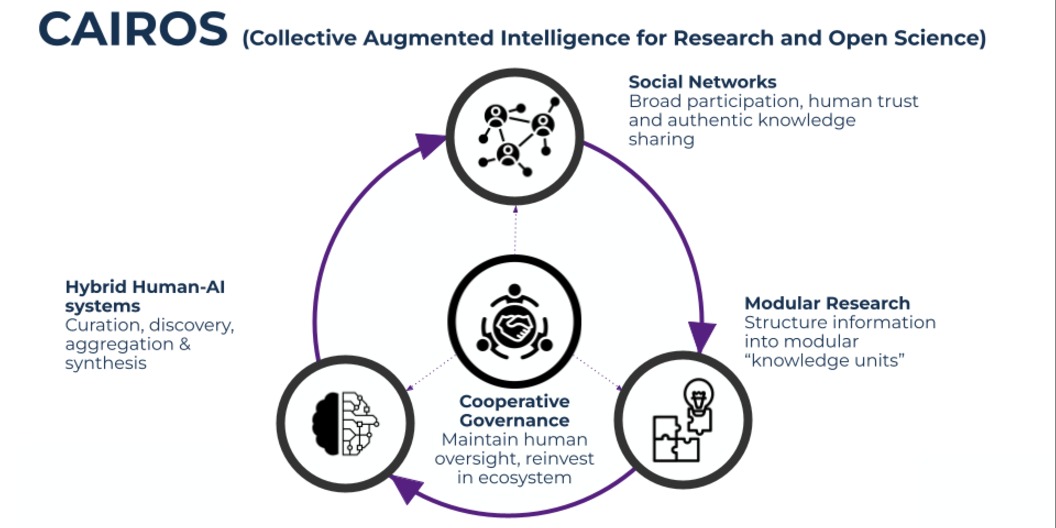
- We launched the CAIROS initiative - a cooperative federation of open science projects working towards collectively stewarded research commons, co-founded with Discourse Graphs. CAIROS aims to forge new paths for mission-driven open science ventures by combining modular research, open social networks, and cooperative governance.
- We've been gearing up for the MIRA workshop (Modular Interoperable Research Attribution), a five-day workshop in Ireland this summer. MIRA is organized by Discourse Graphs and other collaborators to design and prototype interoperable frameworks for modular research attribution, bringing together researchers, designers, engineers, and ecosystem specialists to build next generation scientific communication and collaboration systems. We're particularly excited by MIRA's goal of integrating open social protocols like ATProtocol directly into research workflows - bringing social sensemaking and collaborative knowledge building into the heart of the research process itself, rather than treating them as disconnected afterthoughts.
Semble
- Semble has reached over 550 signups, with 200 users who created cards!
- We started to interoperate with other atproto tools! Margin.at is a great atproto annotation tool and it now supports Semble cards and collections. We're also working on the other direction - bringing Margin content into Semble - the integration is expected to launch soon. The killer app of atproto is interop.
The killer app of atproto is interop
— Tynan Purdy (@tynanpurdy.com) 2026-01-26T14:54:58.435Z
- We added media type detection to links added to Semble, so you can now filter by content type, including research, videos, books, code and more.
Here’s the full list of currently detected types - let us know if you want to see others!
— Semble (@semble.so) 2026-01-23T15:28:19.291Z
- We launched Semble search, adding a powerful discovery layer to the platform. Search for cards and collections, and filter by media type or by people you follow. Try it at semble.so/search! (no need to sign up)
Semble search is now live, adding a powerful discovery layer to Semble! Check it out at semble.so/search Here’s what makes it different >
— Semble (@semble.so) 2026-01-28T00:12:01.396Z
- The ATProto Science projects page now uses a Semble collection as its data source, automatically updating when new projects are added to the collection without needing to edit the website HTML. We see this as just the start of a broader movement to put links "on protocol" - imagine reading lists, project portfolios, and resource collections that can be shared, remixed, and discovered in entirely new ways across the ATProto ecosystem.
atproto is literally reactive web
— dan (@danabra.mov) 2026-01-22T20:53:13.612Z
- Oh, and we gave Semble its own atproto account! Follow us at @semble.so
On Our Radar
- So many great ATProto Science projects! Check them out in the aforementioned Semble collection.
- From Albums to Streams: How Modularity Changes Systems - by Rowan Cockett from Continuous Science Foundation on unbundling research into modular knowledge: “In a physical world of .. printed journals, bundling made sense. In a digital world, we are increasingly constrained by boundaries that no longer make sense. In a world of AI, what does the bundle prevent us from seeing?”
- Context Widows - Great piece around the question “can LLMs do science” and a useful reframing of the discussion: “The better question is whether LLMs can be usefully integrated in the processes by which scientific knowledge gets made, validated, and disseminated.”